Misconceptions & The Path Forward
The Honest Conversation
This lesson is different. We're not going to sell you on how amazing everything is. We're going to have the conversation that experienced developers have—the one that acknowledges what's hype and what's real.
Misconception #1: "Selenium Is Dead"
What you hear: "Playwright and Cypress have killed Selenium. Don't bother learning it." What developers actually say:> "Selenium isn't dead, but let's be brutally honest: the glory days are over. What we thought was 'automation' turned out to be a house of cards—slow, flaky, expensive to maintain."
The reality:- Selenium skills appear in 70%+ of QA job listings globally
- Over 40,000 U.S. job posts require Selenium
- Large enterprises don't replace tools quickly—it's a business decision, not just technical
- Selenium 4 added CDP, BiDi, and relative locators—it's evolving
Misconception #2: "AI Will Replace QA Engineers"
What you hear: "AI can write all your tests. Manual testers will be unemployed." What experienced testers say:> "I spend more time debugging AI decisions than I ever spent maintaining traditional tests."
> — 10-year automation veteran
> "These tools are designed by people who don't actually do testing. They solve problems that sound important in marketing meetings but don't address the real challenges we face."
> — r/QualityAssurance user
The data:- 67% of testers only trust AI-generated tests with mandatory human review
- The most experienced engineers are the most skeptical
- Companies with AI are 70% faster in test cycles, but QA headcount stays the same
- Workers spend 4.3 hours/week reviewing AI outputs—new work that didn't exist before
Misconception #3: "AI Testing Tools Are Magic"
What the marketing says: "Self-healing tests! Zero maintenance! Natural language automation!" What happens in practice:> "We tried three different AI-powered testing tools. Each promised to reduce maintenance overhead. Each created more work than it saved."
> — r/softwaretesting user
> "It's not really natural language—it's domain-specific language that happens to use English words."
> — QA engineer on "no-code" AI tools
The numbers:- 82% AI tool adoption hasn't translated to satisfaction
- Most teams disable AI features within 3 months
- 23% higher false positive rates with self-healing vs. traditional maintenance
- Self-healing can mask real bugs by "fixing" tests to validate wrong behavior
Misconception #4: "Automate Everything"
What you hear: "100% automation coverage is the goal." Why this is wrong:- Not everything has positive ROI for automation
- Flaky tests waste more time than they save
- Exploratory testing finds bugs automation misses
- UI changes break E2E tests constantly
> "AI is an amplifier—if you have strong testing fundamentals, it makes you efficient. If you don't, it helps you produce bad results faster."
Misconception #5: "I Don't Need to Learn AI Tools"
What some testers think: "This AI stuff is hype. It'll pass. I'll stick to what I know." Why this is dangerous:- 65% of organizations use generative AI regularly (doubled from 2023)
- Testers who use AI will replace those who don't
- Even basic AI usage (test generation, locator suggestions) saves 30-40% time
What AI Actually Does Well vs. Poorly
AI Does Well
| Capability | Real-World Value |
|---|---|
| Generating boilerplate test code | Saves time on repetitive structure |
| Suggesting locators | Helps when DOM is complex |
| Creating test data variations | Good for data-driven tests |
| Visual regression detection | Catches CSS issues humans miss |
| Analyzing logs and failures | Speeds up debugging |
AI Does Poorly
| Limitation | Why It Matters |
|---|---|
| Understanding YOUR business rules | It doesn't know your domain |
| Knowing what SHOULD vs CAN be tested | It tests everything equally |
| Exploratory testing creativity | Can't think "what if..." like humans |
| Judging bug severity | Doesn't understand business impact |
| Knowing when a "passing" test is wrong | No intuition for correctness |
The Career Path Forward
The QA career is evolving. Here's the realistic trajectory:
Manual Tester
     ↓
Automation Engineer (You are here, or heading here)
     ↓
SDET (Software Development Engineer in Test)
     ↓
Quality Architect / Engineering Manager
Skills to Build (In Order)
Phase 1: Foundation- Programming (Python or Java)
- Selenium WebDriver fundamentals
- Git version control
- Basic SQL
- API testing (Postman, RestAssured)
- CI/CD integration (GitHub Actions, Jenkins)
- Docker basics
- Performance testing concepts
- Playwright or Cypress (modern alternative)
- AI tools for test generation
- Cloud testing platforms
- Security testing basics
The T-Shaped Professional
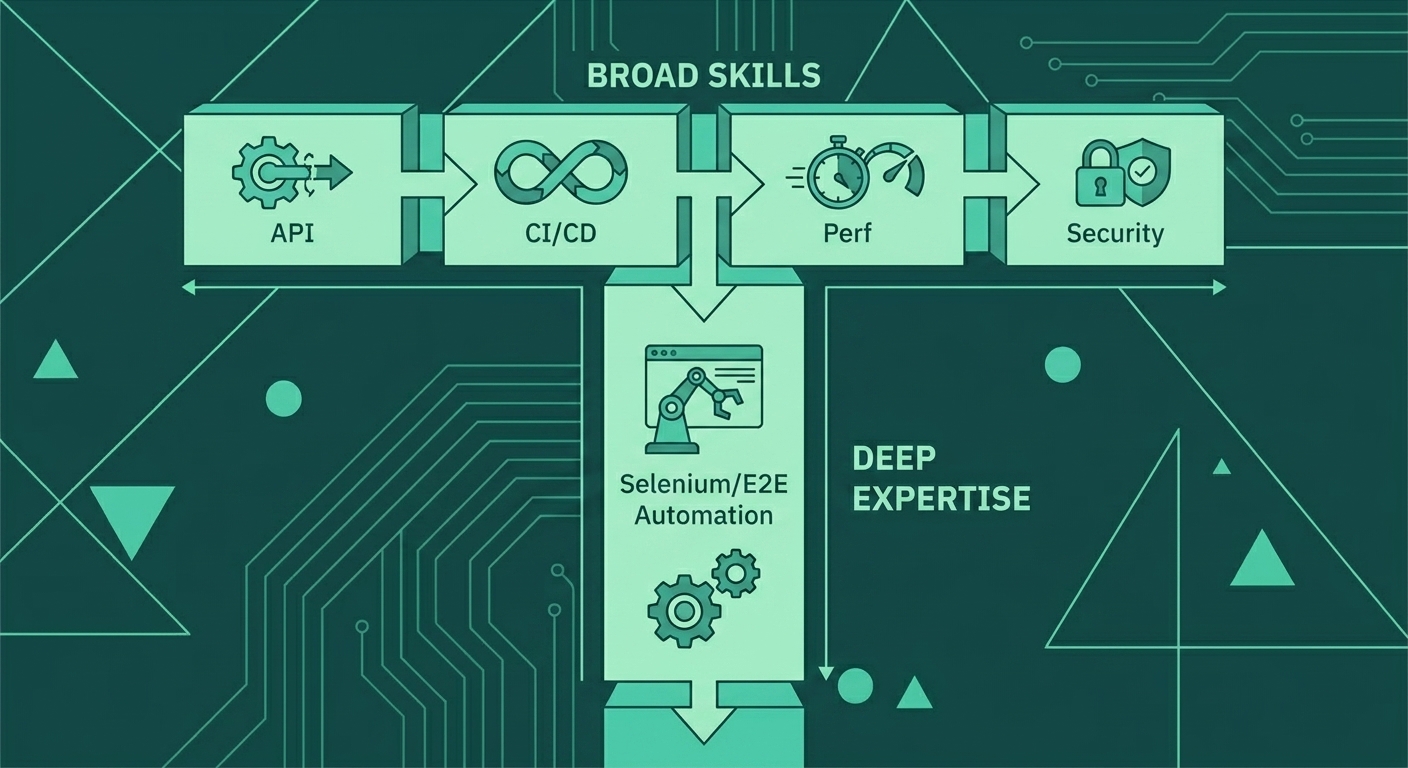
Be good at many things, excellent at one. Develop broad knowledge across API testing, CI/CD, performance, and security—while building deep expertise in Selenium and E2E automation.
Real Talk: What Actually Works
From developers who've been doing this for years:
What Works
- Page Object Model - Still the best pattern for maintainable tests
- Explicit waits - Stop using
Thread.sleep()forever - Selective automation - Test critical paths, not everything
- CI integration - Tests that don't run automatically don't matter
- AI for assistance - Use ChatGPT/Claude to generate boilerplate, not entire test suites
What Doesn't Work
- Record-and-playback - Creates unmaintainable garbage
- 100% automation goals - Leads to flaky, valueless suites
- Trusting AI blindly - Always review generated code
- Ignoring fundamentals - AI amplifies skill, doesn't replace it
- Over-engineering - Start simple, add complexity when needed
The Mindset Shift
| From | To |
|---|---|
| "I run tests" | "I design quality strategy" |
| "Automation replaces manual" | "Automation amplifies manual" |
| "AI will take my job" | "AI will change my job" |
| "More tests = better" | "Valuable tests = better" |
| "Selenium vs. Playwright" | "Right tool for the job" |
Key Takeaways
- Selenium isn't dead - But learn modern tools too
- AI augments, doesn't replace - The job changes, it doesn't disappear
- Most AI hype is overblown - 82% of teams disable AI features within months
- Fundamentals still matter - AI amplifies your skills, not replaces them
- Build a T-shaped career - Broad knowledge, deep expertise
Honest Self-Assessment
Before continuing, ask yourself:
- Am I learning automation because it's valuable, or because I'm afraid of being replaced?
- Have I tried AI tools with realistic expectations, or dismissed them entirely?
- Am I building skills that will matter in 5 years, or just chasing trends?
Next Lesson
Now that we've set realistic expectations, let's get practical. In Setting Up Selenium 4, we'll install everything you need and write your first test against a real e-commerce application.