Why DSA Matters
Understanding data structures and algorithms isn't just for passing interviews—it's fundamental to writing efficient, scalable software.
The Real-World Impact
Consider searching for a name in a phone book:
- Linear Search: Check each name one by one → O(n)
- Binary Search: Open to the middle, eliminate half each time → O(log n)
For a phone book with 1 million names:
- Linear: Up to 1,000,000 comparisons
- Binary: Only ~20 comparisons!
Linear vs Non-Linear Data Structures
Data structures are broadly categorized into two types based on how elements are arranged:
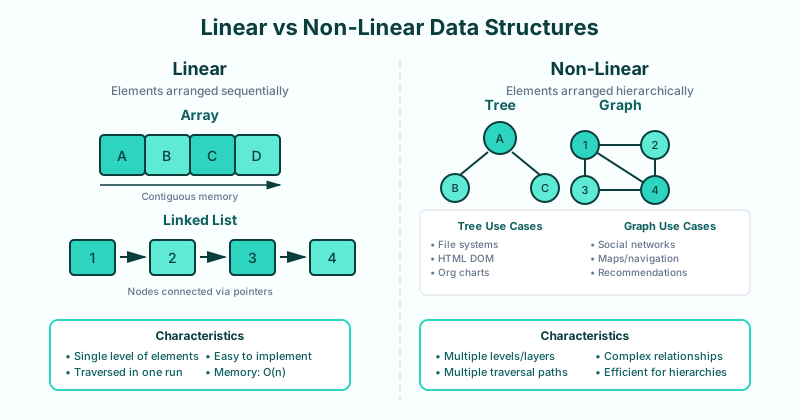
Linear Data Structures
Elements are arranged sequentially, one after another.
| Structure | Best For | Access | Insert/Delete |
|---|---|---|---|
| Array | Index-based access | O(1) | O(n) |
| Linked List | Frequent insertions | O(n) | O(1) |
| Stack | LIFO operations | O(1) | O(1) |
| Queue | FIFO operations | O(1) | O(1) |
When to Use Linear Structures
- Simple, ordered data
- Known size or sequential access patterns
- Undo/redo functionality (Stack)
- Task scheduling (Queue)
Non-Linear Data Structures
Elements are arranged hierarchically or in a network.
| Structure | Best For | Search | Insert |
|---|---|---|---|
| Binary Tree | Hierarchical data | O(log n) | O(log n) |
| Graph | Complex relationships | Varies | O(1) |
| Hash Table | Key-value lookups | O(1) avg | O(1) avg |
When to Use Non-Linear Structures
- Hierarchical relationships (file systems, org charts)
- Network relationships (social networks, maps)
- Fast lookups by key (databases, caches)
Why Companies Care About DSA
- Scalability - Code that works for 100 users might fail for 1 million
- Performance - Milliseconds matter in user experience
- Problem-Solving - DSA teaches you to think systematically
- Code Quality - Right structure = cleaner, maintainable code
What's Next?
In the next lesson, we'll learn how to measure efficiency using Big O notation—the language for comparing algorithm performance.