Trees
A Tree is a hierarchical data structure consisting of nodes connected by edges. Unlike linear structures, trees branch out from a single root node.
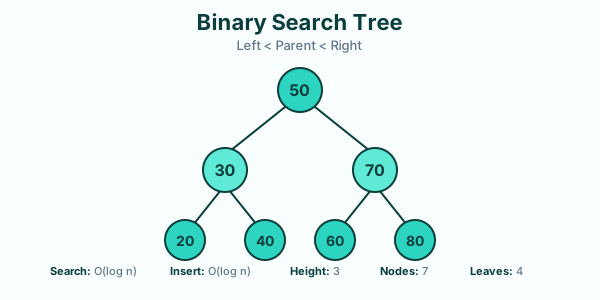
Tree Terminology
| Term | Definition |
|---|---|
| Root | Top node with no parent |
| Node | Element containing data and child references |
| Edge | Connection between two nodes |
| Leaf | Node with no children |
| Parent | Node with children below it |
| Child | Node directly below another node |
| Height | Longest path from root to leaf |
| Depth | Distance from root to a node |
Binary Tree
A Binary Tree is a tree where each node has at most 2 children (left and right).
class TreeNode {
  constructor(value) {
    this.value = value;
    this.left = null;
    this.right = null;
  }
}
Binary Search Tree (BST)
A BST is a binary tree with a special property:
- Left subtree contains values less than the parent
- Right subtree contains values greater than the parent
This property enables O(log n) search!
BST Implementation
class BST {
  constructor() {
    this.root = null;
  }

  insert(value) {
    const newNode = new TreeNode(value);
    if (!this.root) {
      this.root = newNode;
      return;
    }

    let current = this.root;
    while (true) {
      if (value < current.value) {
        if (!current.left) {
          current.left = newNode;
          return;
        }
        current = current.left;
      } else {
        if (!current.right) {
          current.right = newNode;
          return;
        }
        current = current.right;
      }
    }
  }

  search(value) {
    let current = this.root;
    while (current) {
      if (value === current.value) return true;
      if (value < current.value) {
        current = current.left;
      } else {
        current = current.right;
      }
    }
    return false;
  }
}

// Usage
const bst = new BST();
bst.insert(50);
bst.insert(30);
bst.insert(70);
bst.insert(20);
bst.insert(40);
console.log(bst.search(40)); // true
console.log(bst.search(45)); // false
Tree Traversals
1. In-Order (Left, Root, Right)
Visits nodes in sorted order for BST.
function inOrder(node) {
  if (!node) return;
  inOrder(node.left);
  console.log(node.value);
  inOrder(node.right);
}
// Output: 20, 30, 40, 50, 60, 70, 80
2. Pre-Order (Root, Left, Right)
Used to copy a tree or get prefix expression.
function preOrder(node) {
  if (!node) return;
  console.log(node.value);
  preOrder(node.left);
  preOrder(node.right);
}
// Output: 50, 30, 20, 40, 70, 60, 80
3. Post-Order (Left, Right, Root)
Used to delete a tree or get postfix expression.
function postOrder(node) {
  if (!node) return;
  postOrder(node.left);
  postOrder(node.right);
  console.log(node.value);
}
// Output: 20, 40, 30, 60, 80, 70, 50
4. Level-Order (BFS)
Visits nodes level by level using a queue.
function levelOrder(root) {
  if (!root) return;
  const queue = [root];
  while (queue.length) {
    const node = queue.shift();
    console.log(node.value);
    if (node.left) queue.push(node.left);
    if (node.right) queue.push(node.right);
  }
}
// Output: 50, 30, 70, 20, 40, 60, 80
BST Operations Complexity
| Operation | Average | Worst (Unbalanced) |
|---|---|---|
| Search | O(log n) | O(n) |
| Insert | O(log n) | O(n) |
| Delete | O(log n) | O(n) |
Types of Trees
| Type | Description |
|---|---|
| Binary Tree | Max 2 children per node |
| BST | Binary tree with ordering property |
| AVL Tree | Self-balancing BST |
| Red-Black Tree | Self-balancing with color rules |
| B-Tree | Multi-way tree for databases |
| Trie | Prefix tree for strings |
Real-World Applications
- File Systems — Directory structure
- DOM — HTML document tree
- Databases — B-trees for indexing
- Autocomplete — Trie data structure
- Decision Making — Decision trees in ML
What's Next?
Next, we'll explore Graphs — the most general data structure that can represent any relationship between objects, essential for social networks, maps, and many algorithms.