Queues
A Queue is a linear data structure that follows the FIFO (First In, First Out) principle. Think of a line at a coffee shop — the first person in line gets served first.
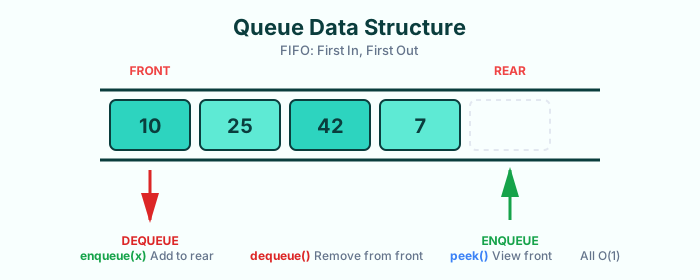
Core Operations
All basic queue operations are O(1) — constant time!
| Operation | Description | Time |
|---|---|---|
| enqueue(x) | Add element to rear | O(1) |
| dequeue() | Remove and return front element | O(1) |
| peek() / front() | View front element without removing | O(1) |
| isEmpty() | Check if queue is empty | O(1) |
| size() | Get number of elements | O(1) |
Implementation
Using an Array
class Queue {
  constructor() {
    this.items = [];
  }

  enqueue(element) {
    this.items.push(element);
  }

  dequeue() {
    if (this.isEmpty()) {
      return "Queue is empty";
    }
    return this.items.shift();
  }

  peek() {
    if (this.isEmpty()) {
      return "Queue is empty";
    }
    return this.items[0];
  }

  isEmpty() {
    return this.items.length === 0;
  }

  size() {
    return this.items.length;
  }
}

// Usage
const queue = new Queue();
queue.enqueue(10);
queue.enqueue(25);
queue.enqueue(42);
console.log(queue.peek());    // 10 (first in)
console.log(queue.dequeue()); // 10 (first out)
console.log(queue.peek());    // 25
Python Implementation
from collections import deque

class Queue:
    def __init__(self):
        self.items = deque()

    def enqueue(self, item):
        self.items.append(item)

    def dequeue(self):
        if not self.is_empty():
            return self.items.popleft()
        return None

    def peek(self):
        if not self.is_empty():
            return self.items[0]
        return None

    def is_empty(self):
        return len(self.items) == 0
Stack vs Queue
| Aspect | Stack | Queue |
|---|---|---|
| Principle | LIFO | FIFO |
| Add | push() to top | enqueue() to rear |
| Remove | pop() from top | dequeue() from front |
| Example | Undo button | Print queue |
| Algorithm | DFS | BFS |
Types of Queues
1. Simple Queue
Standard FIFO queue we've been discussing.
2. Circular Queue
The rear connects back to the front, efficiently using fixed-size arrays.
[_, _, 3, 4, 5]  →  [6, 7, 3, 4, 5]
      ↑  rear wraps around to front
3. Priority Queue
Elements have priorities; highest priority is dequeued first.
// Often implemented with a heap
// Used in: Dijkstra's algorithm, task scheduling
4. Double-Ended Queue (Deque)
Insert and delete from both ends.
const deque = [];
deque.push(1);      // Add to rear
deque.unshift(0);   // Add to front
deque.pop();        // Remove from rear
deque.shift();      // Remove from front
Real-World Applications
- Print Queue — Documents printed in order received
- Task Scheduling — CPU processes tasks in order
- BFS Algorithm — Exploring graphs level by level
- Message Queues — Kafka, RabbitMQ for async processing
- Customer Service — Call centers, ticket systems
BFS with a Queue
function bfs(graph, start) {
  const visited = new Set();
  const queue = [start];
  visited.add(start);

  while (queue.length > 0) {
    const node = queue.shift(); // Dequeue
    console.log(node);

    for (const neighbor of graph[node]) {
      if (!visited.has(neighbor)) {
        visited.add(neighbor);
        queue.push(neighbor); // Enqueue
      }
    }
  }
}
What's Next?
Next, we'll explore Linked Lists — a dynamic data structure where elements are connected through pointers, allowing efficient insertions and deletions.