Graphs
A Graph is a non-linear data structure consisting of vertices (nodes) and edges (connections). Graphs can represent any relationship between objects.
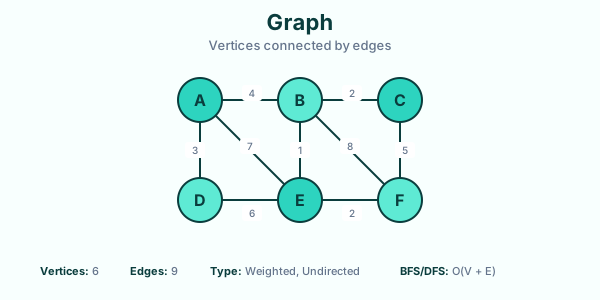
Graph Terminology
| Term | Definition |
|---|---|
| Vertex (Node) | A point in the graph |
| Edge | Connection between two vertices |
| Directed | Edges have direction (one-way) |
| Undirected | Edges are bidirectional |
| Weighted | Edges have values (costs, distances) |
| Path | Sequence of vertices connected by edges |
| Cycle | Path that starts and ends at same vertex |
| Degree | Number of edges connected to a vertex |
Types of Graphs
Undirected          Directed            Weighted
  A---B             A→→→B               A--5--B
  |   |             ↑   ↓               |     |
  D---C             D←←←C               3     2
                                        |     |
                                        D--4--C
Graph Representation
1. Adjacency List (Most Common)
Each vertex stores a list of its neighbors.
const graph = {
  'A': ['B', 'D'],
  'B': ['A', 'C', 'E'],
  'C': ['B', 'F'],
  'D': ['A', 'E'],
  'E': ['B', 'D', 'F'],
  'F': ['C', 'E']
};2. Adjacency Matrix
2D array where matrix[i][j] = 1 if edge exists.
//     A  B  C  D
// A [ 0, 1, 0, 1 ]
// B [ 1, 0, 1, 0 ]
// C [ 0, 1, 0, 1 ]
// D [ 1, 0, 1, 0 ]

const matrix = [
  [0, 1, 0, 1],
  [1, 0, 1, 0],
  [0, 1, 0, 1],
  [1, 0, 1, 0]
];Graph Traversals
Breadth-First Search (BFS)
Explores level by level using a queue.
function bfs(graph, start) {
  const visited = new Set();
  const queue = [start];
  const result = [];

  visited.add(start);

  while (queue.length > 0) {
    const vertex = queue.shift();
    result.push(vertex);

    for (const neighbor of graph[vertex]) {
      if (!visited.has(neighbor)) {
        visited.add(neighbor);
        queue.push(neighbor);
      }
    }
  }

  return result;
}

// bfs(graph, 'A') → ['A', 'B', 'D', 'C', 'E', 'F']Depth-First Search (DFS)
Goes as deep as possible using a stack (or recursion).
function dfs(graph, start) {
  const visited = new Set();
  const result = [];

  function explore(vertex) {
    visited.add(vertex);
    result.push(vertex);

    for (const neighbor of graph[vertex]) {
      if (!visited.has(neighbor)) {
        explore(neighbor);
      }
    }
  }

  explore(start);
  return result;
}

// dfs(graph, 'A') → ['A', 'B', 'C', 'F', 'E', 'D']BFS vs DFS
| Aspect | BFS | DFS |
|---|---|---|
| Data Structure | Queue | Stack/Recursion |
| Approach | Level by level | Go deep first |
| Shortest Path | Yes (unweighted) | No |
| Memory | O(V) worst | O(V) worst |
| Use Case | Shortest path | Cycle detection |
Complexity
| Operation | Adjacency List | Adjacency Matrix |
|---|---|---|
| Add Vertex | O(1) | O(V²) |
| Add Edge | O(1) | O(1) |
| Remove Edge | O(E) | O(1) |
| Query Edge | O(V) | O(1) |
| BFS/DFS | O(V + E) | O(V²) |
| Space | O(V + E) | O(V²) |
Common Graph Algorithms
| Algorithm | Purpose |
|---|---|
| Dijkstra's | Shortest path (weighted) |
| Bellman-Ford | Shortest path (negative weights) |
| Kruskal's/Prim's | Minimum spanning tree |
| Topological Sort | Order dependencies |
| Floyd-Warshall | All pairs shortest path |
Real-World Applications
- Social Networks — Friends, followers, connections
- Maps & Navigation — Roads, shortest routes
- Web Crawling — Pages linked to other pages
- Recommendation Systems — Product relationships
- Dependency Resolution — Package managers, build systems
What's Next?
Congratulations! You've completed the core data structures. The final lesson is a comprehensive quiz to test your understanding of everything you've learned.