Three-Agent Architecture Pattern
Evolution from Two to Three Agents
The two-agent pattern works, but has limitations:
- Self-evaluation bias: Coders tend to rate their own work highly
- No quality gate: Features pass without rigorous testing
- Missing planning: Complex features need upfront design
Anthropic's three-agent harness addresses these:
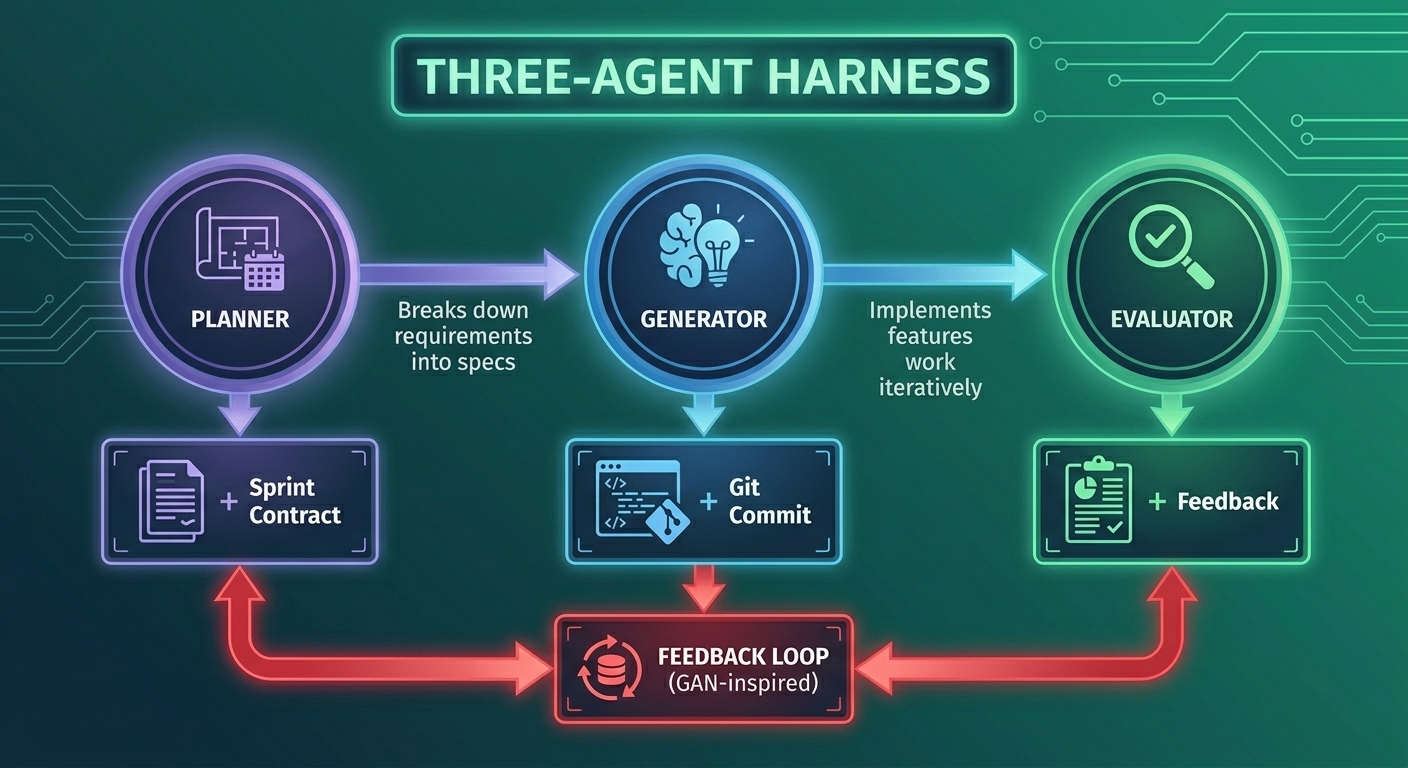
The Planner Agent
The Planner converts vague requirements into detailed specifications:
Responsibilities
interface PlannerAgent {
  // Convert requirements to detailed spec
  createProductSpec(requirements: string): Promise<ProductSpec>;

  // Break spec into implementable sprints
  createSprintPlan(spec: ProductSpec): Promise<Sprint[]>;

  // Define acceptance criteria
  createSprintContract(sprint: Sprint): Promise<SprintContract>;
}
Product Specification
interface ProductSpec {
  overview: {
    name: string;
    description: string;
    targetUsers: string[];
    coreValue: string;
  };

  technicalStack: {
    frontend: string;      // "React + Vite + TypeScript"
    backend: string;       // "FastAPI + SQLite"
    styling: string;       // "TailwindCSS"
    testing: string;       // "Playwright"
  };

  features: Feature[];

  constraints: {
    timeline: string;
    complexity: 'low' | 'medium' | 'high';
    qualityBar: string;
  };
}
Sprint Contracts
Before implementation, Planner and Generator negotiate explicit agreements:
interface SprintContract {
  sprintId: string;
  feature: string;

  // What "done" looks like
  acceptanceCriteria: {
    criterion: string;
    testable: boolean;
    verificationMethod: string;
  }[];

  // Testable behaviors
  behaviors: {
    given: string;
    when: string;
    then: string;
  }[];

  // What the evaluator will check
  evaluationCriteria: {
    dimension: string;
    weight: number;
    passingScore: number;
  }[];
}{
"sprintId": "sprint-001",
"feature": "User Registration",
"acceptanceCriteria": [
{
"criterion": "User can submit registration form",
"testable": true,
"verificationMethod": "Playwright form submission test"
},
{
"criterion": "Validation errors display for invalid input",
"testable": true,
"verificationMethod": "Test with invalid email format"
},
{
"criterion": "Success message shows after registration",
"testable": true,
"verificationMethod": "Check for success toast/message"
}
],
"behaviors": [
{
"given": "User is on registration page",
"when": "User submits valid email and password",
"then": "Account is created and success message displays"
},
{
"given": "User is on registration page",
"when": "User submits invalid email format",
"then": "Validation error displays under email field"
}
],
"evaluationCriteria": [
{ "dimension": "functionality", "weight": 0.4, "passingScore": 0.8 },
{ "dimension": "design", "weight": 0.3, "passingScore": 0.7 },
{ "dimension": "code_quality", "weight": 0.3, "passingScore": 0.7 }
]
}The Generator Agent
The Generator implements features based on sprint contracts:
Responsibilities
interface GeneratorAgent {
  // Implement feature according to contract
  implementFeature(contract: SprintContract): Promise<Implementation>;

  // Self-evaluate before handoff
  selfEvaluate(implementation: Implementation): Promise<SelfEvaluation>;

  // Use git for version control
  commitChanges(message: string): Promise<void>;
}
Implementation Pattern
async function generatorSession(contract: SprintContract) {
  console.log(`🔨 Generator: Starting ${contract.feature}`);

  // 1. Read the sprint contract
  const criteria = contract.acceptanceCriteria;
  const behaviors = contract.behaviors;

  // 2. Implement each acceptance criterion
  for (const criterion of criteria) {
    console.log(`  📝 Implementing: ${criterion.criterion}`);

    // Generate code
    await implementCriterion(criterion);

    // Test locally
    const localTest = await runLocalTest(criterion);
    if (!localTest.passed) {
      console.log(`  ⚠️ Local test failed, fixing...`);
      await fixImplementation(criterion, localTest.error);
    }

    // Commit incrementally
    await bash(`git add .`);
    await bash(`git commit -m "feat: ${criterion.criterion}"`);
  }

  // 3. Self-evaluate before handoff
  const selfEval = await selfEvaluate(contract);
  console.log(`  📊 Self-evaluation: ${selfEval.score}/100`);

  // 4. Create handoff document for evaluator
  await writeFile('handoff-to-evaluator.json', JSON.stringify({
    sprintId: contract.sprintId,
    feature: contract.feature,
    selfEvaluation: selfEval,
    commitHash: await bash('git rev-parse HEAD'),
    readyForEvaluation: true
  }));

  console.log(`✅ Generator: Handoff ready for Evaluator`);
}
The Evaluator Agent
The Evaluator provides rigorous, unbiased assessment:
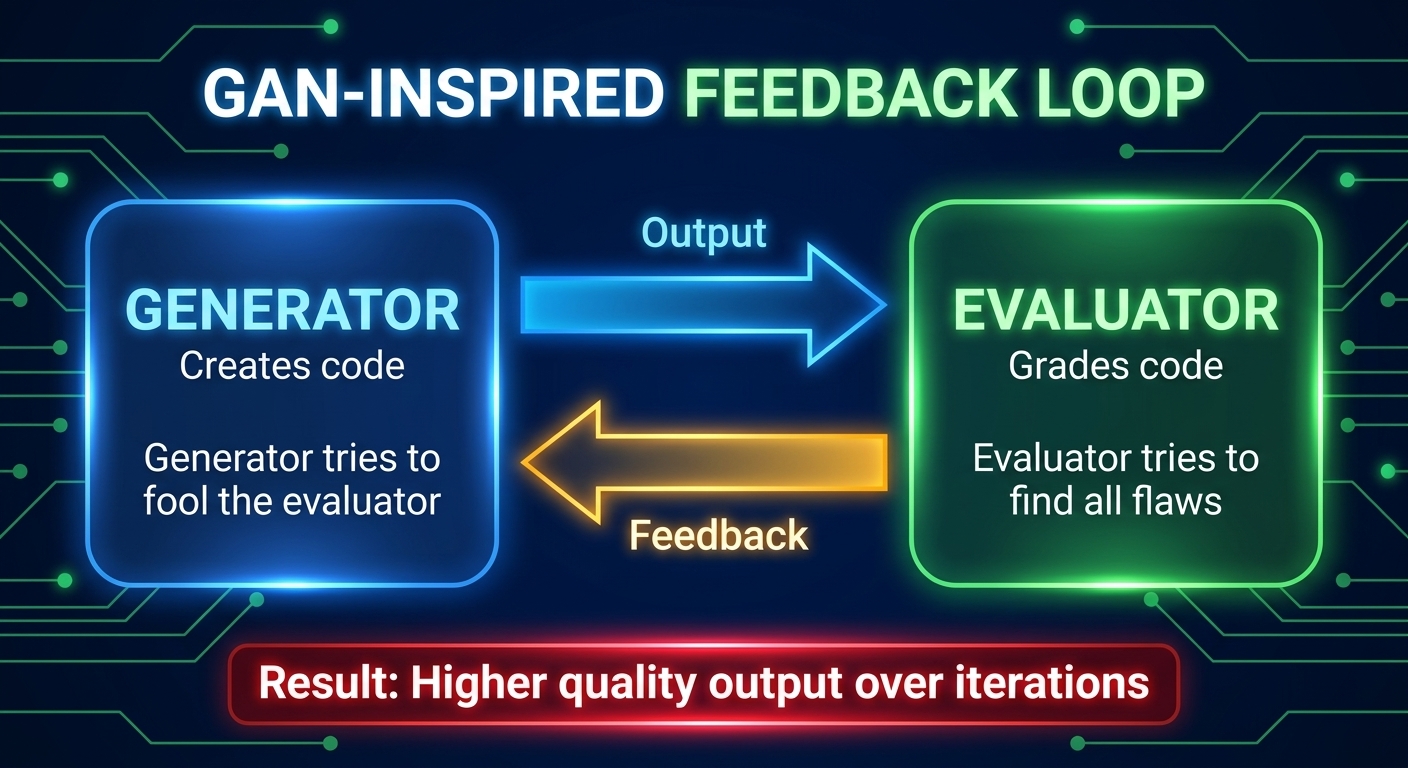
GAN-Inspired Design
The evaluator is inspired by the discriminator in Generative Adversarial Networks:
Evaluation Criteria
Anthropic's evaluator uses four dimensions:
interface EvaluationCriteria {
  designQuality: {
    description: "Coherence, mood, identity";
    rubric: {
      excellent: "Cohesive design language, clear visual hierarchy";
      good: "Consistent styling, minor inconsistencies";
      poor: "Inconsistent, no clear design system";
    };
    weight: 0.25;
  };

  originality: {
    description: "Custom decisions vs template defaults";
    rubric: {
      excellent: "Unique design choices, memorable";
      good: "Some customization beyond defaults";
      poor: "Generic, looks like unmodified template";
    };
    weight: 0.25;
  };

  craft: {
    description: "Typography, spacing, color harmony";
    rubric: {
      excellent: "Polished details, pixel-perfect";
      good: "Well-executed, minor issues";
      poor: "Sloppy, inconsistent spacing/alignment";
    };
    weight: 0.25;
  };

  functionality: {
    description: "Usability and task completion";
    rubric: {
      excellent: "All features work flawlessly";
      good: "Core features work, minor bugs";
      poor: "Critical features broken";
    };
    weight: 0.25;
  };
}
Evaluator Implementation
async function evaluatorSession(handoff: HandoffDocument) {
  console.log(`🔍 Evaluator: Reviewing ${handoff.feature}`);

  // 1. Load sprint contract
  const contract = await loadSprintContract(handoff.sprintId);

  // 2. Start the application
  await bash('npm run dev &');
  await sleep(3000); // Wait for server

  // 3. Run Playwright tests for each behavior
  const behaviorResults = [];
  for (const behavior of contract.behaviors) {
    const result = await runPlaywrightTest(behavior);
    behaviorResults.push({
      behavior: behavior,
      passed: result.passed,
      screenshot: result.screenshot,
      error: result.error
    });
  }

  // 4. Grade each dimension
  const grades = {
    designQuality: await gradeDesign(behaviorResults),
    originality: await gradeOriginality(behaviorResults),
    craft: await gradeCraft(behaviorResults),
    functionality: await gradeFunctionality(behaviorResults)
  };

  // 5. Calculate weighted score
  const finalScore = calculateWeightedScore(grades, contract.evaluationCriteria);

  // 6. Generate feedback
  const feedback = await generateDetailedFeedback(grades, behaviorResults);

  // 7. Make pass/fail decision
  const passed = finalScore >= contract.evaluationCriteria
    .reduce((sum, c) => sum + c.passingScore * c.weight, 0);

  // 8. Write evaluation report
  await writeFile('evaluation-report.json', JSON.stringify({
    sprintId: handoff.sprintId,
    feature: handoff.feature,
    grades,
    finalScore,
    passed,
    feedback,
    behaviorResults
  }));

  console.log(`📊 Evaluator: Score ${finalScore}/100 - ${passed ? 'PASSED' : 'FAILED'}`);

  if (!passed) {
    console.log(`📝 Feedback for Generator:`);
    feedback.improvements.forEach(i => console.log(`  - ${i}`));
  }

  return { passed, feedback };
}
The Feedback Loop
When the evaluator rejects work, the generator iterates:
async function runThreeAgentHarness(requirements: string) {
  // Phase 1: Planning
  const planner = new PlannerAgent();
  const spec = await planner.createProductSpec(requirements);
  const sprints = await planner.createSprintPlan(spec);

  // Phase 2 & 3: Generation + Evaluation loop
  for (const sprint of sprints) {
    const contract = await planner.createSprintContract(sprint);

    let passed = false;
    let attempts = 0;
    const maxAttempts = 3;

    while (!passed && attempts < maxAttempts) {
      attempts++;
      console.log(`\n🔄 Sprint ${sprint.id} - Attempt ${attempts}/${maxAttempts}`);

      // Generator implements
      const generator = new GeneratorAgent();
      await generator.implementFeature(contract);

      // Evaluator grades
      const evaluator = new EvaluatorAgent();
      const result = await evaluator.evaluate(contract);

      passed = result.passed;

      if (!passed && attempts < maxAttempts) {
        // Feed feedback back to generator
        await generator.incorporateFeedback(result.feedback);
      }
    }

    if (!passed) {
      console.log(`❌ Sprint ${sprint.id} failed after ${maxAttempts} attempts`);
      // Human intervention needed
    }
  }
}
When to Use Three Agents vs Two
| Scenario | Recommended Pattern |
|---|---|
| Simple CRUD app | Two-agent |
| Complex UI with design requirements | Three-agent |
| Backend API only | Two-agent |
| Full-stack with quality bar | Three-agent |
| Prototype/MVP | Two-agent |
| Production-quality product | Three-agent |
E-Commerce Three-Agent Example
ecommerce-three-agent/
├── agents/
│   ├── planner.ts        # Converts requirements to specs
│   ├── generator.ts      # Implements features
│   └── evaluator.ts      # Tests and grades
├── contracts/
│   ├── auth-sprint.json
│   ├── products-sprint.json
│   ├── cart-sprint.json
│   └── checkout-sprint.json
├── evaluations/
│   └── [generated reports]
└── harness.ts
Key Takeaways
- Three agents separate concerns - Planning, Implementation, Evaluation
- Sprint contracts define "done" - Explicit acceptance criteria
- GAN-inspired feedback - Evaluator drives quality improvement
- Self-evaluation is biased - Separate evaluator catches issues
- Iteration improves output - Multiple attempts with feedback
Practice Exercise
Design a three-agent harness for a dashboard application:
- Create a product spec with Planner output format
- Design sprint contracts for 3 features
- Define evaluation criteria specific to dashboards
- Write the feedback loop logic
Next Lesson
Now that we understand agent architectures, let's dive into Session Management & State Persistence - the techniques that enable work across multiple context windows.