Introduction to Agent Harnesses
What is an Agent Harness?
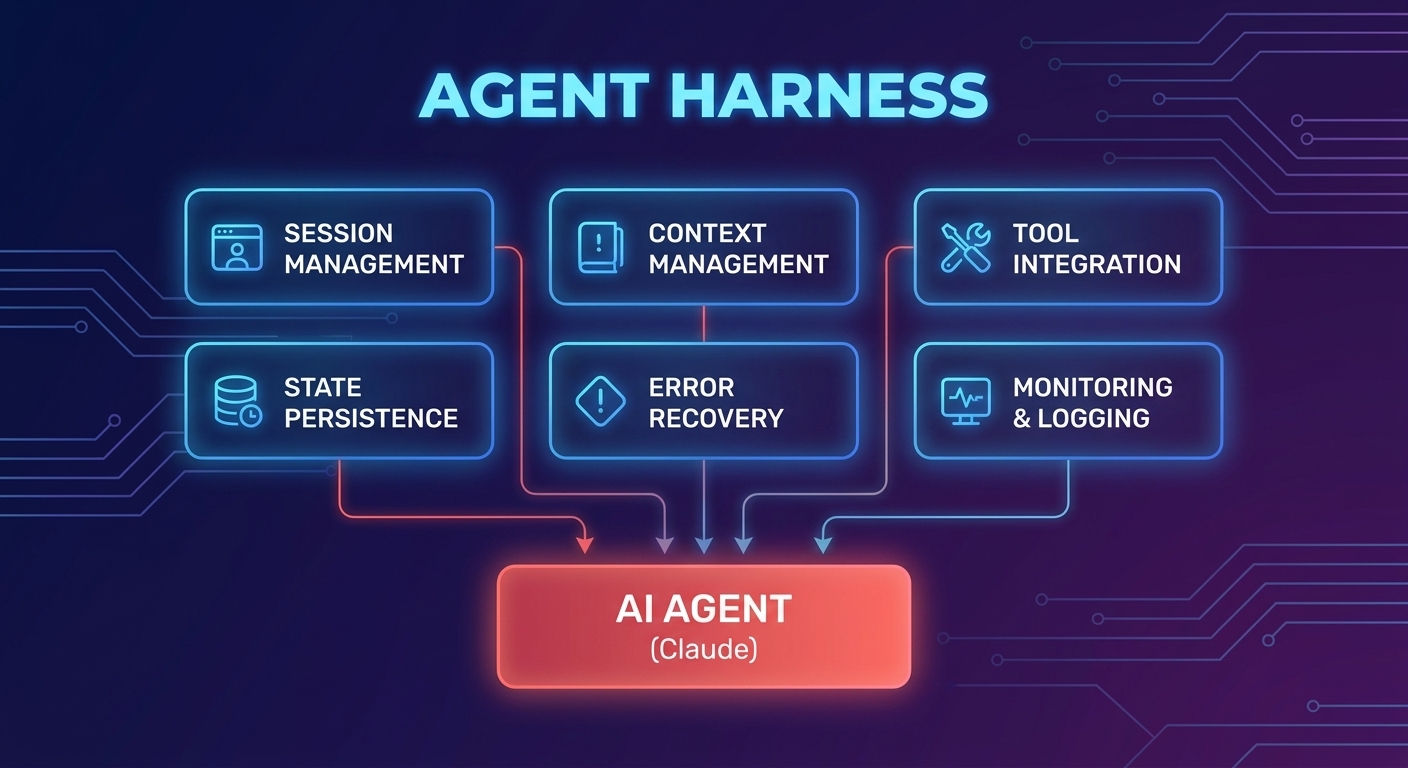
An agent harness is the infrastructure and orchestration layer that enables AI agents to perform complex, long-running tasks reliably. While an agent is the AI model that reasons and acts, the harness is the scaffolding that manages the agent's lifecycle, context, state, and interactions with external systems.
Think of it like this:
- Agent = The brain (Claude, GPT-4, etc.)
- Harness = The body, nervous system, and environment
Why Harnesses Matter in 2025-2026
The AI industry has evolved rapidly:
| Year | Focus | Challenge |
|---|---|---|
| 2023 | Prompts | Getting coherent outputs |
| 2024 | Agents | Connecting models to tools |
| 2025 | Multi-Agent | Coordinating multiple agents |
| 2026 | Harnesses | Enabling sustained, reliable work |
The Problem Harnesses Solve
Consider this scenario: You want Claude to build a full e-commerce application. This involves:
- Setting up the project structure
- Building authentication
- Creating product catalog
- Implementing shopping cart
- Building checkout flow
- Adding payment integration
- Writing tests
- Deploying
- Agent loses context after ~100K tokens
- No memory between sessions
- Can't track what's been completed
- Might redo work or break existing features
- No way to verify work quality
- Manages context across sessions
- Tracks progress in structured files
- Maintains git history for rollbacks
- Runs automated tests to verify work
- Coordinates multiple specialized agents
Real-World Example: Claude Code
Claude Code itself is an agent harness. When you use it:
claude "Build a REST API with authentication"The harness handles:
- Context compaction: Summarizing old context to fit new information
- Tool execution: Running bash commands, reading/writing files
- Session persistence: Remembering conversation history
- Error recovery: Handling failed commands gracefully
Harness vs Framework vs Library
| Component | Purpose | Example |
|---|---|---|
| Library | Reusable code | LangChain, LlamaIndex |
| Framework | Structured approach | CrewAI, AutoGen |
| Harness | Production infrastructure | Claude Agent SDK, Managed Agents |
A harness is more opinionated and production-focused than a framework. It makes specific architectural decisions about:
- How agents communicate
- How state persists
- How errors are handled
- How work is validated
The Anthropic Approach
Anthropic's engineering team developed their harness patterns by observing how human engineers work:
> "We drew inspiration from practices effective software engineers do every day."
Key observations:
- Engineers don't hold entire codebases in memory
- They use git to track changes and enable rollbacks
- They write tests to verify their work
- They document progress for future sessions
- They break large tasks into smaller chunks
The agent harness encodes these practices into infrastructure that AI agents can use.
What You'll Learn in This Course
- Architecture Patterns: Two-agent and three-agent designs
- Session Management: Bridging context windows
- State Persistence: File-based communication
- Testing: Browser automation for verification
- Git Integration: Version control for agents
- Production Deployment: Scaling and monitoring
E-Commerce Application: Course Project
Throughout this course, we'll build a harness that enables an AI agent to construct an e-commerce platform:
E-Commerce Harness
├── initializer/           # Setup agent
│   ├── project-setup.ts
│   └── feature-list.json
├── coder/                 # Implementation agent
│   ├── session-manager.ts
│   └── progress-tracker.ts
├── evaluator/             # Testing agent
│   ├── browser-tests.ts
│   └── grading-criteria.json
└── shared/
    ├── git-helpers.ts
    └── context-manager.ts
By the end, you'll have a working harness that can:
- Initialize new projects with proper structure
- Implement features incrementally across sessions
- Test work using browser automation
- Track progress and maintain context
Key Takeaways
- Agent harnesses are infrastructure for long-running AI tasks
- 2026 is the year of harnesses - the competitive advantage has shifted
- Harnesses encode human engineering practices into AI workflows
- Building reliable harnesses requires session management, state persistence, and validation
- Anthropic's approach uses multi-agent architectures with specialized roles
Next Lesson
In the next lesson, we'll dive deep into the context window problem - the fundamental challenge that harnesses are designed to solve.